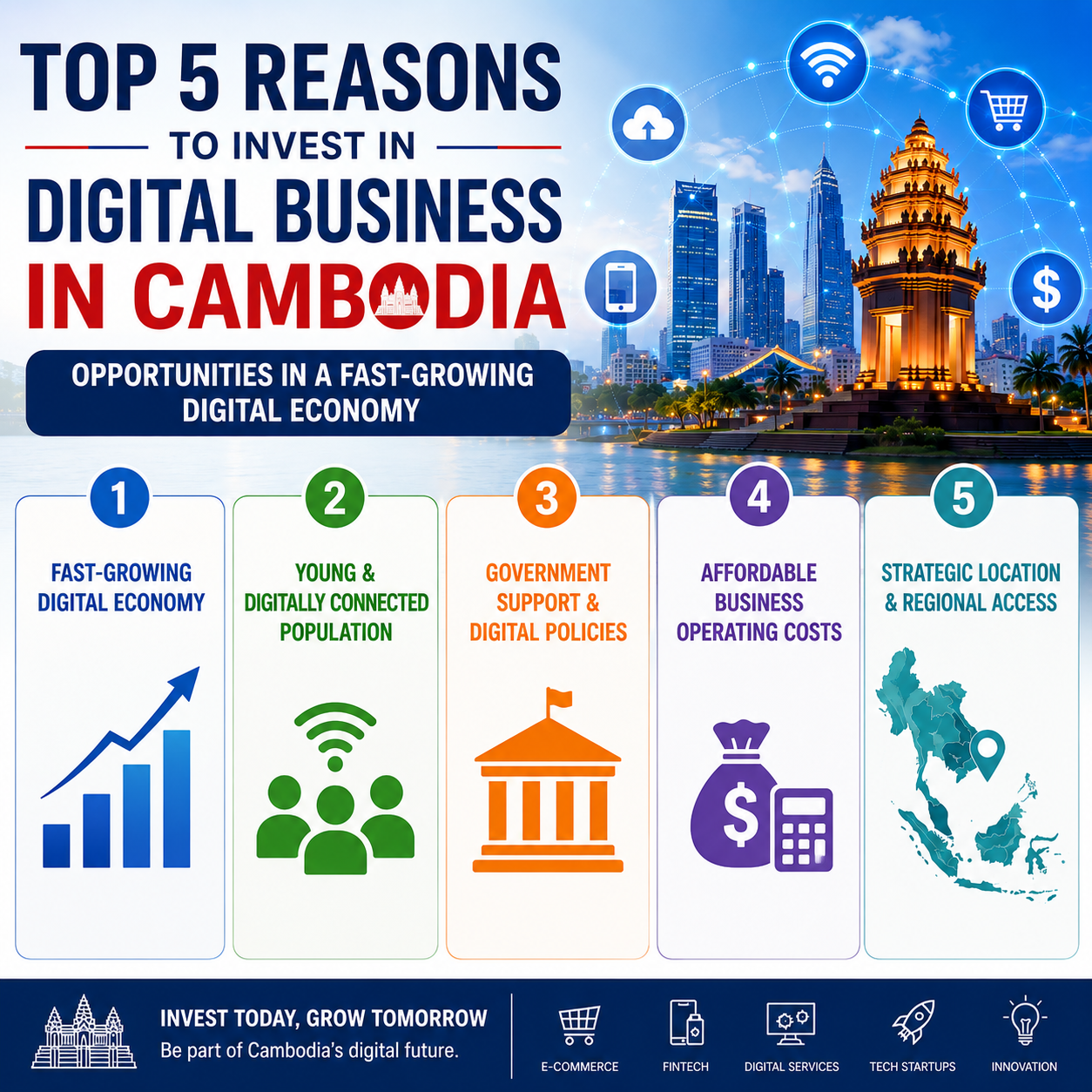
Top 5 Reasons to Invest in Digital Business in Cambodia Opportunities in a Fast-Growing Digital Economy
Cambodia’s economy looks pretty different than it did ten years ago. Garments, tourism, and rice exports used to carry most of the weight. The real tech scene is taking shape too by focusing on Fintech apps, startup incubators around Phnom Penh, and the supportive from government to push toward e-governance and digital payments in Cambodia. It’s still early days compared to somewhere like Vietnam, Thailand, Malaysia, and some countries in ASEAN; however, the direction is obvious if you’ve been paying attention. The rise of smartphones, affordable internet access, digital payments, e-commerce platforms, and government digital initiatives has created a strong foundation for a new generation of digital businesses. From fintech and artificial intelligence (AI) to online education, cybersecurity, smart agriculture, and digital services, Cambodia is becoming an attractive destination for investors looking for opportunities in Southeast Asia. For entrepreneurs and investors, Cambodia’s worth a look by young population, workable business conditions, and demand for tech that’s only going up. Nothing’s guaranteed, but the ingredients are there.
Below are the top 5 reasons why investors should consider Cambodia as a new destination for digital business investment.
Cambodia Has a Fast-Growing Digital Economy
Cambodia’s digital economy is developing rapidly as businesses, consumers, and government institutions increasingly adopt digital technologies. Businesses here are ditching manual, paper-based processes for digital platforms, and gradually customers are moving online right along with them. But there’s still a gap between what companies can offer digitally and this is what customers actually want. The important thing is exactly where most new startups are finding place to operate in Cambodia. Key growth areas such as E-commerce platforms, digital financial services, software development, cloud computing, artificial intelligence solutions, cybersecurity services, digital marketing, online education platforms, etc. More Cambodian businesses are figuring out that going digital isn’t optional anymore. For investors, that’s basically the pitch of a market that Cambodia offers opportunities to enter with plenty of room left to grow before it starts looking like its neighbours.
A Young and Digital-Friendly Population
A large percentage of Cambodians are young people who are comfortable using smartphones, social media, mobile applications, and online services. As the well-known countries now for Cambodia is one of greatest advantages is its young population. If we take a look to this demographic is providing advantage that creates both a strong consumer market and a future workforce. The widespread use of smartphones has significantly influenced the digital behaviour of Cambodian youth, and the new apps and platforms have been adopted so fast, and they don’t need much convincing to try something new. For a company building digital products, that’s the kind of audience you want. Social media also plays a vital role in shaping consumer behaviour among young Cambodians. Facebook, TikTok, Instagram, YouTube, and Telegram are widely used for communication, entertainment, news consumption, and even business transactions. Cambodia’s young workforce is also a hiring advantage due to their graduations mostly consist of digital knowledge and technical skills; therefore, the companies can recruit talent capable of supporting software development, customer service, digital marketing, and business innovation.
Affordable Business Operating Costs
The biggest selling point for starting a digital business in Cambodia comes down to unit economics: it’s cheap. Compared to Thailand, Malaysia, or Singapore, operating costs are low enough that a small team can survive its first couple of lean years without burning through funding on basic overhead like rent and salaries. Labour is the biggest piece of that. Developers, marketers, designers, support staff cost less to hire here than in the neighbouring countries, and the quality gap has narrowed as more graduates come out of local IT and business programs. Training people up internally is cheap enough that a small company can actually afford to do it, not just the bigger firms. Registering a business doesn’t take much capital, and the government has moved a lot of that process online, cutting down the paperwork. Digital businesses have it even easier since there’s no warehouse or retail space to maintain. Marketing is cheap as well. Ads on Facebook, TikTok, and Instagram cost a fraction of what TV or print used to, and you can target the audience you actually want instead of hoping the right people notice a billboard. What all this leaves you with is more room to spend on the business itself: product, security, hiring, growth, rather than pouring the budget into rent and licenses. For a startup, that longer runway is often the difference between running out of cash and actually turning a profit. Rising Demand for Digital Services that both consumers and businesses are seeking digital solutions that improve convenience, efficiency, and productivity such as financial technology (FinTech), digital marketing agencies, software and mobile development, cybersecurity services, cloud computing, artificial intelligence solutions, business process automation, online education platforms, digital healthcare applications, etc.
Government Support for Digital Economy
The Cambodian government has made digital transformation an official priority, and a fair stack of policies has followed: pushes toward innovation, digital entrepreneurship, e-government services, and broader tech adoption across industries. In practice that means work on infrastructure, cybersecurity, and digital skills training, along with efforts to make the regulatory side less painful for tech companies and startups. Whether that translates into real investor confidence is a different question than the policy language answers, but the commitment at least looks like a long game rather than a one-off push.
Ministries Most Relevant to Digital SMEs
If you are discussing Digital Business or Digital SME development, these ministries play the most significant roles:
- Ministry of Posts and Telecommunications (MPTC) – Digital infrastructure, digital economy, cybersecurity, AI, digital government, and ICT policy.
- Ministry of Industry, Science, Technology and Innovation (MISTI) – SME digital transformation, innovation, Industry 4.0, and technology adoption.
- Ministry of Commerce (MoC) – E-commerce, digital trade, online business registration, and export promotion.
- Ministry of Economy and Finance (MEF) – Digital finance, taxation, fintech policy, and investment incentives.
- Ministry of Education, Youth and Sport (MoEYS) – Digital skills, ICT education, and workforce development.
- Ministry of Labour and Vocational Training (MLVT) – Digital workforce training and upskilling.
- Ministry of Interior (MoI) – Digital identity, civil registration, and cybersecurity coordination.
- Ministry of Information (MoInfo) – Digital media, online communications, and public awareness.
- Ministry of Foreign Affairs and International Cooperation (MFAIC) – International digital cooperation and cross-border partnerships.
- Ministry of Tourism (MoT) – Digital tourism, smart tourism platforms, and online promotion.
These ministries work together to support Cambodia’s digital transformation agenda through policies, infrastructure development, digital skills, innovation, e-commerce, and support programmes for SMEs.
Innovation and Startup Ecosystem
Cambodia’s startup ecosystem has grown steadily with the support of incubators, accelerators, innovation hubs, universities, venture capital firms, and entrepreneurship programmes. Increasing investment in startups encourages innovation in sectors such as fintech, Agri-tech, edtech, health tech, and digital commerce. Young entrepreneurs are developing locally relevant digital solutions that address Cambodian market needs while also attracting international attention.
In Short
If you look closely at Southeast Asia right now, Cambodia stands out for a very specific reason: speed of adoption. The population is young, online, and quick to try new digital tools. Combine that with a supportive regulatory environment and low friction to launch, and it’s clear why early-stage founders are quietly moving in. You aren’t just saving cash on payroll here but also; you’re building in a market with massive room to run