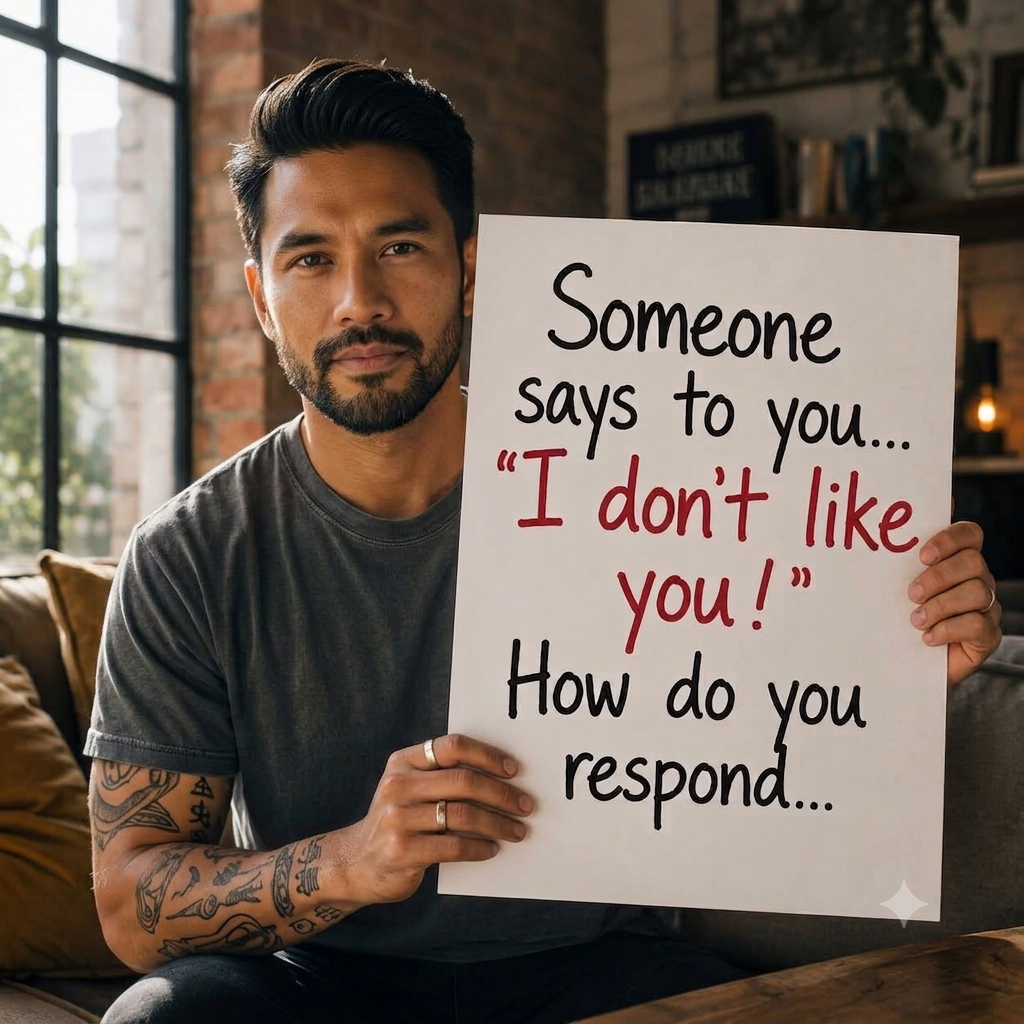
30 Ways to Respond When Someone Says “I Don’t Like You”
Someone tells you they don’t like you and your stomach drops a little. Totally normal. The instinct is to argue your case, get defensive, or fire something back just as sharp. None of that usually helps.
What actually helps: not needing them to take it back.
I’ve grouped these by the kind of response they are, because “I hope you find people you enjoy being around” and “That’s a pretty exclusive club” are doing very different jobs, even though both technically qualify as “mature.”
Just… accepting it
Sometimes the best move is the least dramatic one.
- “That’s okay. Not everyone has to like each other.” True, and saying it out loud usually deflates the moment faster than any comeback would.
- “Thanks for letting me know.” Flat, calm, no charge behind it. That’s the point.
- “I don’t expect everyone to like me.” Because you don’t, right? Nobody actually does, even people who claim otherwise.
- “That’s your choice.” Liking someone isn’t a democratic process. Treating it like one just drags things out.
- “I’m okay with that.” Short sentence, does a lot of work.
- “That’s life.” Sometimes the least profound response is also the correct one.
- “I can live with that.” Not enthusiasm. Not defeat either. Just, fine.
- “Fair enough.” You don’t have to agree with someone to let their opinion land without a fight.
Turning it into an actual conversation
If the relationship matters to you, or you’re genuinely confused, these work better than any deflection:
- “Can I ask why you feel that way?” Curiosity beats defensiveness almost every time.
- “Did I do something to upset you?” Half the time “I don’t like you” is really “you did a thing three weeks ago and I never said anything.”
- “I’d like to understand your perspective.”
- “Is there something we can clear up?”
- “If I’ve made a mistake, I’m willing to listen.”
I’ll be honest, most people skip this whole category because it requires actually being open to hearing “yes, you did something, and here it is.” That’s uncomfortable. It’s also usually where the real information is.
Keeping things civil without pretending to be friends
You don’t need to like someone to be decent around them.
- “I hope we can still be respectful.”
- “We don’t have to be friends to be civil.”
- “I appreciate you being direct.” Genuinely — I’d rather someone tell me than fake it for two years.
- “I respect your honesty.”
Ending it on a generous note
- “No hard feelings.”
- “I wish you the best.” Simple, and it takes the wind out of any attempt to keep the conflict going.
- “I hope you find people you enjoy being around.” This one’s my favorite of the whole list, honestly. It reframes “you’re not for me” as “go find your people” instead of a rejection.
Reminding yourself their opinion isn’t a verdict
These are less for the other person and more for you, said out loud or just in your head:
- “Your opinion doesn’t define me.”
- “I don’t need everyone’s approval.”
- “Not everyone is my audience.” Every book has readers who bounce off it. You’re allowed to be a book.
- “We’re just different people.”
- “I’ll keep being myself.”
When you just want to be a little funny about it
Not every one of these moments needs to be handled with grace. Sometimes a joke does more than a speech.
- “Good thing liking me isn’t a requirement.”
- “That’s a pretty exclusive club.”
- “Well, we finally agree on something: we don’t have to like everyone.”
- “Life would be boring if everyone liked the same people.”
- “Thanks for the feedback. I’ll file it under ‘opinions.'” This is the one I’d actually use. It’s funny without being mean, and it makes clear you’re not losing sleep over it.
You don’t need someone to love you
Here’s the thing nobody says directly enough: trying to get everyone to like you is a losing game, and it usually costs you more of yourself than it’s worth. Every person you’ve ever admired has people who can’t stand them. That’s not a flaw in them, it’s just what happens when you exist in the world with an opinion of your own.
The response you pick matters less than the fact that you didn’t need to win the moment. Calm beats clever most of the time. And weirdly, the people who stop chasing everyone’s approval are usually the ones other people end up liking anyway.