Essential AI Prompts Every General Manager Needs (2026)
Discover 5 battle-tested AI prompts for General Managers to streamline operations, assess strategic risk, evaluate budgets, and lead teams effectively. A General Managers have to carry the whole business in their head at once includes strategy, ops, people, money, the board may be hits usually before 9am. AI isn’t going to replace that judgment; however, the right prompt can act like a sharp advisor who never sleeps. I went through a pile of GM-focused prompts and here are 5 battle-tested AI prompts designed for General Managers; you may can copy.
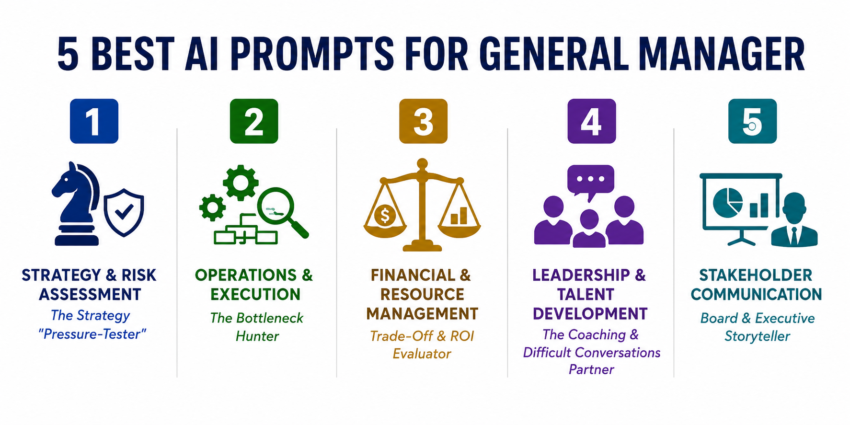
The Strategic Decision
This prompt can be used before evaluating a major initiative, investment, or pivot before it goes to the board.
Prompt:
[Act as an executive leadership team: CEO, CFO, COO, CHRO, and Marketing Director. Evaluate this proposed decision: [describe the decision]. Constraints: [budget, timeline, strategic goals]. From each executive’s point of view, cover:
1. The assumptions this plan depends on to succeed
2. Financial impact: cost, cash flow, long-term ROI
3. Operational and people impact
4. The top 3 ways this could fail under real stress, and the early warning signs to watch for
5. One firm recommendation, with a one-sentence executive summary and an implementation roadmap]
That prompt works because every part of it is doing a job: the role keeps the answers grounded in a real perspective, the constraints stop the model from giving generic advice, and the five questions force specific output instead of a summary. Models respond better when you hand them a role, a scope, a goal, and a shape for the answer, rather than just asking a question.
Operations & Execution: The Bottleneck Hunter
A cross-functional project has stalled, and nobody agrees on why. To make better management decisions and streamlining workflows across siloed departments (e.g., Marketing, Sales, Operations, HR) when projects hit friction points or missed deadlines.
Prompt:
[Act as an Operations Director with expertise in process optimization. Here’s the situation: [describe the process, delays, or team feedback]. Help me:
1. Find the single primary bottleneck causing the delay
2. Point out where cross-functional teams are misaligned, whether that’s goals, incentives, or handoffs
3. Propose a simple 3-step fix that uses minimal extra resources
4. Draft a short, clear message I can send to team leads to align everyone on next steps]
Financial & Resource Management: Trade-Off & ROI Evaluator
The primary purpose of this prompt is to eliminate decision paralysis and subjective bias when allocating high-stakes business capital and it turns an AI model into an objective, analytical sounding board that forces a structured comparison between competing strategic choices.
Prompt:
[Act as a fractional CFO and GM advisor. I’m deciding between Option A: [detail] and Option B: [detail]. Our constraints: [timeline, budget, strategic goals]. Give me:
1. A firm recommendation with a one-sentence executive summary]
2. Weighted pros and cons: cost, speed, execution risk, strategic value
3. The opportunity cost of each option
4. Impact on core KPIs, short-term cash flow versus long-term profitability]
Why it made the cut: most AI “decision help” just lists considerations and leaves you to weigh them. This one makes the model actually pick a side
Leadership & Talent Development: The Coaching & Difficult Conversations Partner
For sensitive 1-on-1s, underperforming leads, or cross-departmental conflicts. Manager should be aware and start preparing some ideas to discuss or negotiate based on business context. Suggest prompts should be modified or adjust accordingly.
Prompt:
[Act as an executive leadership coach. I need to address a performance or behavioral issue with a department head. Here’s the context: [describe the issue or conflict generically, no confidential details]. Help me prepare for this conversation:
1. A clear, measurable standard for what improvement looks like over the next 30 days
2. Four open-ended questions that get them reflecting instead of defensive
3. A direct, empathetic script using the SBI framework (Situation-Behavior-Impact)
4. How to respond if they push back or shift blame mid-meeting]
Stakeholder Communication: Board & Executive Storyteller
The point of pulling operational metrics together for board members, executives, or company-wide updates is simple: turn scattered data into something people can actually act on. GMs deal with a huge amount of daily performance data. CAC, LTV, gross margins, employee churn, inventory turnover, SLA compliance rates. Hand raw numbers like that to C-suite stakeholders and you get cognitive overload, hidden bottlenecks, and decisions that stall. A good executive briefing doesn’t just report numbers. It explains what’s actually going on behind them. When a GM uses a structured framework to bring performance data together, three things happen.
Prompt:
[Act as an Executive Communications Director. I need to summarize our team’s performance data and updates for [Board meeting / Executive Committee / All-hands meeting]. Here’s the raw operational and financial context: [Paste raw metrics, wins, challenges, or department notes]. Turn this into an executive summary formatted as:
1. Next 30-Day Priorities: bulleted focus areas needing executive awareness or approval
2. The Executive Briefing: a 3-sentence overview covering wins, challenges, outlook.
3. Top 3 Strategic Wins: each with the business-impact metric included
4. Key Operational Risks and Countermeasures: what’s lagging and what’s actively being done about it]
Caution:
That’s the gap between a prompt that hands you a decent paragraph and one that hands you something you’d actually act on. Notice what all five prompts have in common:
- A specific persona, not just “act as an expert”
- A real business input you paste in, not a hypothetical one
- Structured output, numbered instead of a wall of text
- Something that forces a decision or action out of it, not just analysis
** Don’t paste confidential financials, unreleased strategy, or identifiable employee details into a public AI tool. Use placeholders like “Department Head X” or normalized percentages instead. The prompts above are written to make that easy.