AI vs. Agentic AI: What’s the Real Difference?
Artificial intelligence (AI) is rapidly changing how people work, learn, communicate, and make decisions. From chatbots and AI writing assistants to image generators and coding tools, AI has become part of everyday digital life.
What “AI” Usually Means
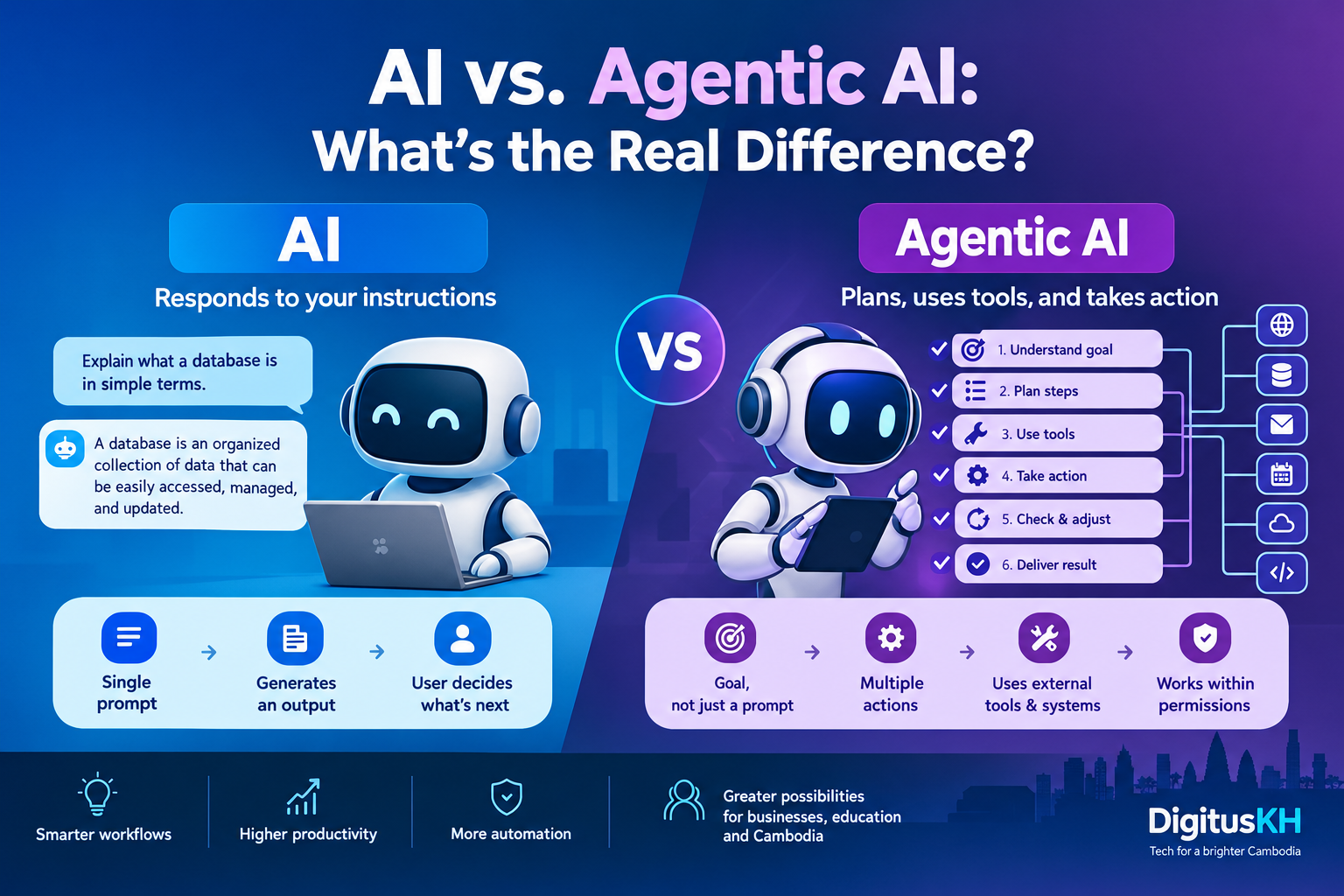
Artificial intelligence (AI) covers a wide range of systems built to do things that normally require human thought such as reading text, recognizing images, translating languages, spotting patterns, writing code, generating content. There are some most visiting AI’s websites that you can try on such as: https://claude.ai/, https://chatgpt.com/, https://gemini.google.com/, etc. and write down as “Explain database normalization in simple terms.” then it reads the question, produces an answer, and stops. You decide what happens next. User → AI → Response. That’s the whole loop. Some tasks that can be included:
- Understanding natural language
- Recognizing images and patterns
- Translating languages
- Analyzing information
- Making predictions
- Generating content
- Writing computer code
- Supporting decision-making
What Is Agentic AI?
Agentic AI is built to chase a goal across multiple steps instead of answering one prompt and quitting. A well-built agent can understand what you’re after, break it into smaller pieces, plan an order of operations, pull in outside information, use tools, act, check its own results, and adjust when something doesn’t work. An AI agent may be designed to:
- Adjust its approach when necessary.
- Understand a goal.
- Break the goal into smaller tasks.
- Plan what needs to be done.
- Gather information.
- Use external tools.
- Perform actions.
- Evaluate results.
Compare a simple request as generative AI “Find some cybersecurity conferences.”; however, Agentic AI will “Find relevant cybersecurity conferences, compare their dates and locations, gather registration details, and put together a summary.” Give an agent the right access, and it can search, organize, compare, and hand you a finished report instead of a list of links.
Goal → Plan → Use tools → Act → Check → Result. That’s the shape of it.
The Actual Difference
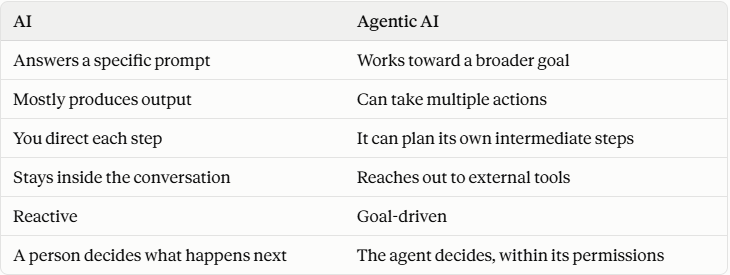
An agentic system often uses a generative model as one piece of a larger machine. Agentic AI is less a different species of AI and more a different architecture: one built to reason through a task, touch real tools, and act on its findings.
A Concrete Example
Say a university wants a weekly student attendance report.
- Old way: a teacher uploads the spreadsheet and asks, “Summarize this attendance data.” The AI reads it and hands back a summary. Done.
- Agentic way: the teacher says, “Prepare the weekly attendance report.” With the right access, the agent can pull the raw data, flag anything missing, calculate rates, notice anything unusual, build charts, draft the report, and send it off for a human to sign off on.
Same underlying analysis. Very different amount of work taken off the teacher’s plate.
Why Tool Access Matters So Much
A model that only generates text is limited to text. Connect it to web search, a database, an API, email, a calendar, a file system, a CRM, or a code environment, and it stops being a text generator and starts being something closer to a coworker. Take IT support. Someone reports: “I can’t access the company’s application.”. An agent with the right permissions can look up the user, check their account status, pull relevant logs, dig into likely causes, suggest a fix, carry out an approved action, and log the ticket without a human doing the legwork at every step. That’s the appeal for business process automation: not that it’s flashy, but that it removes a lot of the manual shuffling between systems.
“Agentic” Doesn’t Mean “No Humans Involved”
People sometimes hear “agentic” and picture something running completely unsupervised. That’s not how most of these systems are actually deployed. Autonomy is a dial, not a switch. On the low end: the AI drafts an email, a person reads it, a person sends it. On the higher end: the AI drafts it, checks it against a set of rules, and sends it without waiting for anyone. For anything sensitive, most organizations keep a human approval step in the loop for what people usually call human-in-the-loop AI. The point isn’t to remove people from the process entirely. It’s to let AI handle what it’s good at while humans keep control over the calls that actually matter.
What Organizations Actually Get Out of It
- Fewer manual handoffs. An agent can carry a task through several stages instead of a person babysitting each one.
- More time for judgment calls. Repetitive workflows get delegated, freeing people up for the parts that need a human brain.
- Faster information gathering. Pulling from multiple sources and organizing it is exactly the kind of grunt work agents handle well.
- Workflows shaped around how you actually work, rather than generic templates.
- Ongoing monitoring some systems watch for a condition and act the moment it’s met, instead of waiting for someone to check in.
None of this is automatic, though. It depends on the quality of the system, the data feeding it, how well it’s integrated, and whether the security and process side is actually in order.
Where It Can Go Wrong
A chatbot that gives a bad answer is annoying. An agent with access to real business systems that takes a wrong action is a different kind of problem entirely.
The main risks worth taking seriously:
- Bad decisions. The agent misreads the instruction or works from bad data.
- Too much access. Handing an agent more system or data permission than the task actually needs is a security problem waiting to happen.
- Privacy. Agents often touch personal, financial, or business data that shouldn’t move around loosely.
- Doing something you didn’t mean. The agent’s interpretation of “the goal” and your actual intent aren’t always the same thing.
- Security. An agent’s instructions, data, and tool access all become attack surface.
- Who’s responsible when it goes wrong. Someone needs to own that answer before the agent is live, not after.
This is why agentic systems need real authentication, clear permission boundaries, logging, monitoring, a human checkpoint should be applied
In Education
Teachers could use agentic tools for lesson prep, quiz generation, digging through student data, report writing, organizing learning materials, and general admin grunt work. Students could use them for research, coding practice, personalized study plans, and finding information faster. None of that removes the need for schools to actually think through their policies involve academic integrity, privacy, what’s appropriate to automate and what isn’t. The goal is AI that supports learning, not AI that quietly does the learning for the student.
What This Could Mean for Cambodian Businesses
Cambodia’s digital economy is a plausible place for agentic AI to matter such as customer service, SME admin, marketing, IT support, reporting, document processing, cybersecurity monitoring, government service workflows, edtech. One thing that matters more here than in a lot of markets: language. Tools that genuinely work well in both Khmer and English will reach a lot more people than ones that only handle English cleanly. But buying an AI tool isn’t the same as getting value from it. That usually takes reliable data, decent digital infrastructure, people who know how to use the tools, security controls, clear processes, some form of governance, a privacy policy, and someone actually watching what the system does.
So Which One Does a Given Organization Actually Need?
There’s no rule that says every business needs an agent. A plain AI assistant is fine for writing, summarizing, translating, brainstorming, basic research, and content generation. Agentic AI starts to earn its keep when the task involves several steps, outside tools, repetitive workflows, retrieving data from more than one place, decision points along the way, or ongoing monitoring. Which one makes sense depends on what you’re trying to do, how much risk you can tolerate, what infrastructure you already have, and how much governance you’re prepared to put around it.
Where This Is Heading
Roughly, plain AI led to generative AI, which led to AI-powered apps, which is leading to agentic AI, and probably toward multi-agent systems working together on bigger workflows. That doesn’t mean everything becomes autonomous. Plenty of tasks will keep being handled by a simple assistant, and that’s fine. The real shift is that AI is moving from just generating information toward actually carrying out the work which changes the question from “what can this thing say” to “what should we let this thing do.”
For Cambodia specifically, that’s the question worth sitting with where does an agent genuinely save time and reduce error, and where does a person still need to be the one making the call?