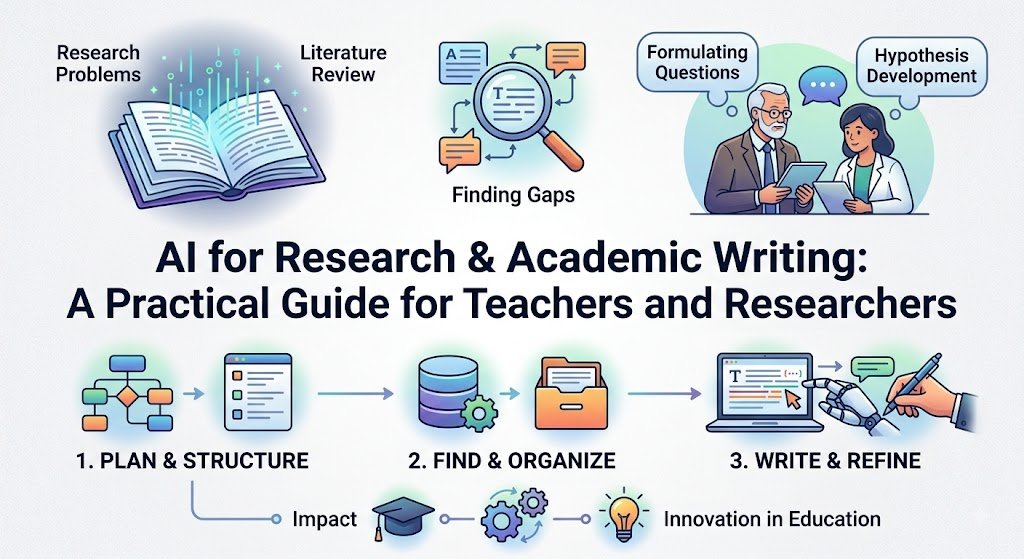
AI for Research & Academic Writing: A Practical Guide for Teachers and Researchers
AI is turning into a real research tool — for teachers, lecturers, researchers, university students, all of it. It can help pick a topic, dig through the literature, organize ideas, clean up the prose, analyse data, even help structure the final paper. But typing “write my research paper” into a chatbot isn’t using AI well. That takes critical thinking, checking its work, actual research skills, and holding the line on academic integrity. Think of it as a research assistant. Not the author. Not the owner of the work.
Below are practical ways to use AI for research and writing, with prompts you can copy and adapt for ChatGPT, Gemini, Claude, Copilot, or whatever you’re using.
Understanding the Role of AI in Academic Research
A typical research process includes:
Research Idea → Problem Identification → Research Questions → Literature Review → Research Design → Data Collection → Data Analysis → Discussion → Writing → Editing → Publication
Researchers can lean on AI for a lot of the process. Early on, it’s useful for brainstorming topics, spotting gaps in the existing research, and shaping those into real questions. Once you’re deeper in, it can help structure a literature review, summarize articles, compare competing theories, and build out a conceptual framework. For methodology, it can help design a questionnaire or draft interview questions, and later help you work through qualitative themes or explain a statistical concept you’re fuzzy on. And for the writing itself: outlines, tightening prose, reviewing arguments, catching weak spots in a draft, pulling out keywords, drafting an abstract. AI can take a first pass at almost all of it. However, researchers should remain responsible for the research methodology, evidence, interpretation, citations, and conclusions.
AI for Finding Research Topics
One of the first challenges researchers face is selecting a good research topic that can be rejected or not significant enough to conduct the research; however, AI can help to generate potential topics based on a researcher’s field; unless research knows how to use prompts accordingly (how to can communicate and command AI to generate what its needs for research). Prompt below just an example for the try:
**Prompt:**

Act as a senior academic researcher specializing in [YOUR FIELD].

I am interested in the following broad area:

[INSERT RESEARCH AREA]

Generate 20 potential research topics that are:

* Relevant to current academic discussions
* Researchable
* Specific rather than overly broad
* Suitable for [Bachelor's/Master's/PhD] research
* Potentially valuable to researchers, organizations, or policymakers

For each topic, provide:

1. Proposed title
2. Research problem
3. Why the topic is important
4. Potential research gap
5. Possible research questions
6. Possible methodology
7. Potential contribution

Rank the topics from most promising to least promising.
AI for Identifying Research Problems
To understand the concept of using prompt for research problem, the definition of the research problem should be defined. A research problem is a clear, specific statement outlining an issue, contradiction, or gap in existing knowledge that your study aims to address. It is the foundation of any academic paper and if without a well-defined problem, a research project lacks direction and purpose. AI can help researchers transform a broad topic into a specific research problem.
**Prompt:**

Act as a senior academic researcher.

My research topic is:

[INSERT TOPIC]

Help me identify a strong research problem.

Analyze:

1. What is currently known?
2. What is not sufficiently understood?
3. What practical problem exists?
4. Who is affected by the problem?
5. Why does the problem matter?
6. What evidence would be needed?
7. What potential research gap could be investigated?

Then propose three alternative research problem statements.

For each version, explain its strengths and weaknesses.
AI for Developing Research Questions
A research question (RQ) is the central inquiry that a study sets out to answer, and it translates that problem into a direct, testable inquiry that guides your methodology, data collection, and analysis. A good research question should be clear, focused, researchable, relevant, and not too broad or too narrow. AI can help refine research questions and align them with the research problem.
**Prompt:**

Act as an experienced research methodology professor.

My research problem is:

[INSERT RESEARCH PROBLEM]

Develop:

1. One main research question
2. Three to five specific research questions
3. Corresponding research objectives
4. Possible hypotheses, if appropriate
5. Key variables or concepts

Ensure that the research questions are aligned with the research problem and suitable for a [qualitative/quantitative/mixed-methods] study.

Explain how each question contributes to answering the main research problem.
AI for Literature Review
Literature review is one of the most important and time-consuming parts of academic research. A literature review pulls together what’s already been published on a topic and makes sense of it as a whole. It’s not the same as an annotated bibliography. Remember, it is not just summarizing paper after paper but mapping the conversation between researchers. The themes that keep coming up, the methods people reach for, where they disagree, and what nobody’s answered yet. Researchers need to find the relevant studies, understand the theories behind them, compare findings, spot where scholars disagree, identify gaps in the research, organize the literature, and build an argument from it all.
**** Do not rely on AI-generated citations without verifying them because AI systems can sometimes generate references that look realistic but do not actually exist.
**Prompt:**

Act as a senior academic researcher.

I am conducting research on:

[INSERT RESEARCH TOPIC]

I will provide academic papers or verified article information.

For each source, analyze:

1. Research objective
2. Research methodology
3. Sample/population
4. Key findings
5. Theoretical framework
6. Limitations
7. Research gaps
8. Relevance to my research

Do not invent information that is not present in the source.

After analysing the sources, identify similarities, differences, contradictions, and potential research gaps.
AI for Comparing Academic Studies
AI can help transform large amounts of research information into a structured comparison and try this prompt
**Prompt:**

I will provide information from several verified academic studies.

Compare the studies based on:

* Author/year
* Research objective
* Research questions
* Methodology
* Sample
* Variables
* Theoretical framework
* Key findings
* Limitations
* Research gaps

Present the comparison in a clear academic table.

Then provide a synthesis explaining:

1. Areas of agreement
2. Areas of disagreement
3. Methodological differences
4. Important limitations
5. Emerging research gaps

Do not add information that is not supported by the provided studies.
AI for Developing a Conceptual Framework
conceptual framework is just a way of showing how you think the pieces of your study fit together such as the variables, the concepts, how they relate. Sometimes that’s a diagram, sometimes it’s written out in a few paragraphs.
For example, research on AI adoption might examine:
AI Knowledge → Perceived Usefulness → Attitude → Intention to Use → Actual AI Adoption
**Prompt:**

Act as a research methodology expert.

My research topic is:

[INSERT TOPIC]

Based on the research problem and verified literature I provide, help me develop a conceptual framework.

Identify:

1. Independent variables
2. Dependent variables
3. Mediating variables
4. Moderating variables
5. Possible relationships
6. Relevant theories

Explain the theoretical justification for each proposed relationship.

Do not invent theories or citations. Clearly identify areas where additional academic sources are required.

Finally, provide a text-based conceptual framework that I can convert into a research diagram.
AI for Research Methodology
Research methodology is the overarching strategy and systematic rationale for how a research project is conducted. It explains how data will be gathered, analysed, and interpreted to answer your research questions and address the core research problem. Quantitative methods work well for measuring relationships, attitudes, adoption, and statistical patterns; qualitative methods are better for understanding experiences, perceptions, and motivations; and mixed methods combine the two.
**Prompt:**

Act as a senior research methodology professor.

My research problem is:

[INSERT PROBLEM]

My research questions are:

[INSERT QUESTIONS]

Compare the suitability of:

1. Quantitative research
2. Qualitative research
3. Mixed-methods research

Evaluate each approach based on:

* Research questions
* Data requirements
* Sample requirements
* Feasibility
* Strengths
* Limitations
* Expected contribution

Recommend the most appropriate methodology and explain why.

Do not make the final decision for me; provide a reasoned methodological recommendation.
AI for Questionnaire Development
For quantitative research on something like AI adoption, AI can help draft questionnaire questions around constructs such as perceived usefulness, ease of use, trust, AI literacy, organizational support, and behavioural intention.
**Prompt:**

Act as an academic survey research specialist.

My research topic is:

[INSERT TOPIC]

My research variables/constructs are:

[INSERT VARIABLES]

Develop a draft questionnaire using a 5-point Likert scale.

For each construct, create 4–6 potential measurement items.

For each item:

* Use clear language
* Measure only one concept
* Avoid leading questions
* Avoid double-barreled questions
* Avoid unnecessary technical terminology

Then explain how each item relates to its construct.

Identify which items require validation using established measurement scales from peer-reviewed literature.
AI for Data Analysis
AI is genuinely useful for the “wait, what does this even mean” moments in analysis. Stuck on what a correlation coefficient is actually telling you, or how ANOVA differs from a t-test? AI can walk you through the basics such as descriptive stats, regression, factor analysis, thematic analysis, whatever you’re staring at. Just don’t take its interpretation of your actual results as gospel. Go back and check the data yourself and check the methodology too. Explaining a concept is one thing. Confirming you ran the test right on your own data is a different job, and it’s still yours.
**Prompt:**

Act as a statistics professor.

I will provide my statistical results:

[INSERT RESULTS]

Explain:

1. What each statistic means
2. Whether the result is statistically significant
3. The practical meaning of the finding
4. The relationship between variables
5. Important limitations
6. What should and should not be concluded

Use academically appropriate language.

Do not invent missing statistical values.

Clearly distinguish statistical significance from practical significance.
Understanding the Role of AI in Academic Writing
Writing is probably where AI pulls the most weight. It’s good at the mechanical stuff includes clunky sentences, grammar slips, academic tone, paragraph order, transitions, cutting the fat, tightening up a shaky argument. But there’s a real line between that and handing it the whole paper while you sit back and wait. The argument has to stay yours. That’s the part no tool gets to take from you. The basic prompt you can try
**Prompt:**

Act as an academic editor.

I will provide a section of my research paper.

Improve the writing while preserving my original meaning and arguments.

Focus on:

* Academic tone
* Grammar
* Clarity
* Logical flow
* Conciseness
* Paragraph structure
* Appropriate transitions

Do not introduce new claims, statistics, theories, or citations.

Do not change the meaning of my research.

After editing, briefly identify the major improvements you made.
AI for Writing an Abstract
An abstract is basically the paper in miniature: background, the problem, your objective, methodology, key findings, conclusion, and what it actually adds to the field. AI won’t help much before the research is done, since there’s nothing to summarize yet, but once you’ve got real results, it’s useful for tightening that summary up.
**Prompt:**

Act as an academic journal editor.

Using only the information I provide, write a concise academic abstract for my research.

Research title:
[INSERT TITLE]

Background:
[INSERT]

Research problem:
[INSERT]

Objective:
[INSERT]

Methodology:
[INSERT]

Key findings:
[INSERT]

Conclusion:
[INSERT]

Contribution:
[INSERT]

Do not invent findings, statistics, references, or conclusions.

Provide:

1. A 150-word version
2. A 250-word version
3. Five academic keywords
AI for Reviewing Your Research Before Submission
Before sending anything off, it’s worth having AI pick the whole paper apart of the research questions, whether the logic actually holds together, the methodology, how well the argument is made, the literature review, the discussion, the limitations, even the writing itself. Treat it like a harsh reviewer who hasn’t read your earlier drafts and has no reason to be nice.
**Prompt:**

Act as a highly critical peer reviewer for an academic journal.

Review the following research paper:

[INSERT PAPER]

Evaluate:

1. Research significance
2. Research problem
3. Research questions
4. Literature review
5. Research gap
6. Methodology
7. Data analysis
8. Findings
9. Discussion
10. Conclusions
11. Limitations
12. Academic writing
13. Logical consistency

Identify:

* Major weaknesses
* Minor weaknesses
* Unsupported claims
* Missing evidence
* Methodological concerns
* Areas requiring clarification

Finally, provide a prioritized revision plan.

Be critical but constructive.
What researcher or academic writer should know
Last but not least, from user to generative AI-Assistant, researcher or academic writer should know that AI can genuinely make research and writing better. But its real value isn’t generating text. Plenty of tools do that and it’s acting as a thinking partner. AI cannot replace researcher or writer; however, it can help as a research assistant and sometimes becomes editor to bounce ideas off between idea and research question, between literature and methodology, between raw analysis and a finished paper.
A few things matter if you want this to actually work, though. Think before you prompt and don’t let AI decide where your research goes. Lean on real academic sources, not AI itself as evidence. Check everything it gives you, especially citations and statistics; it gets confidently wrong more than people expect. Don’t feed it confidential or identifying information about participants just because it’s convenient. Don’t fabricate anything, ever and keep yourself at the centre as AI can suggest and organize and edit all day, but the call is still yours.