What IT Skills Should Cambodian Students Learn in 2026?
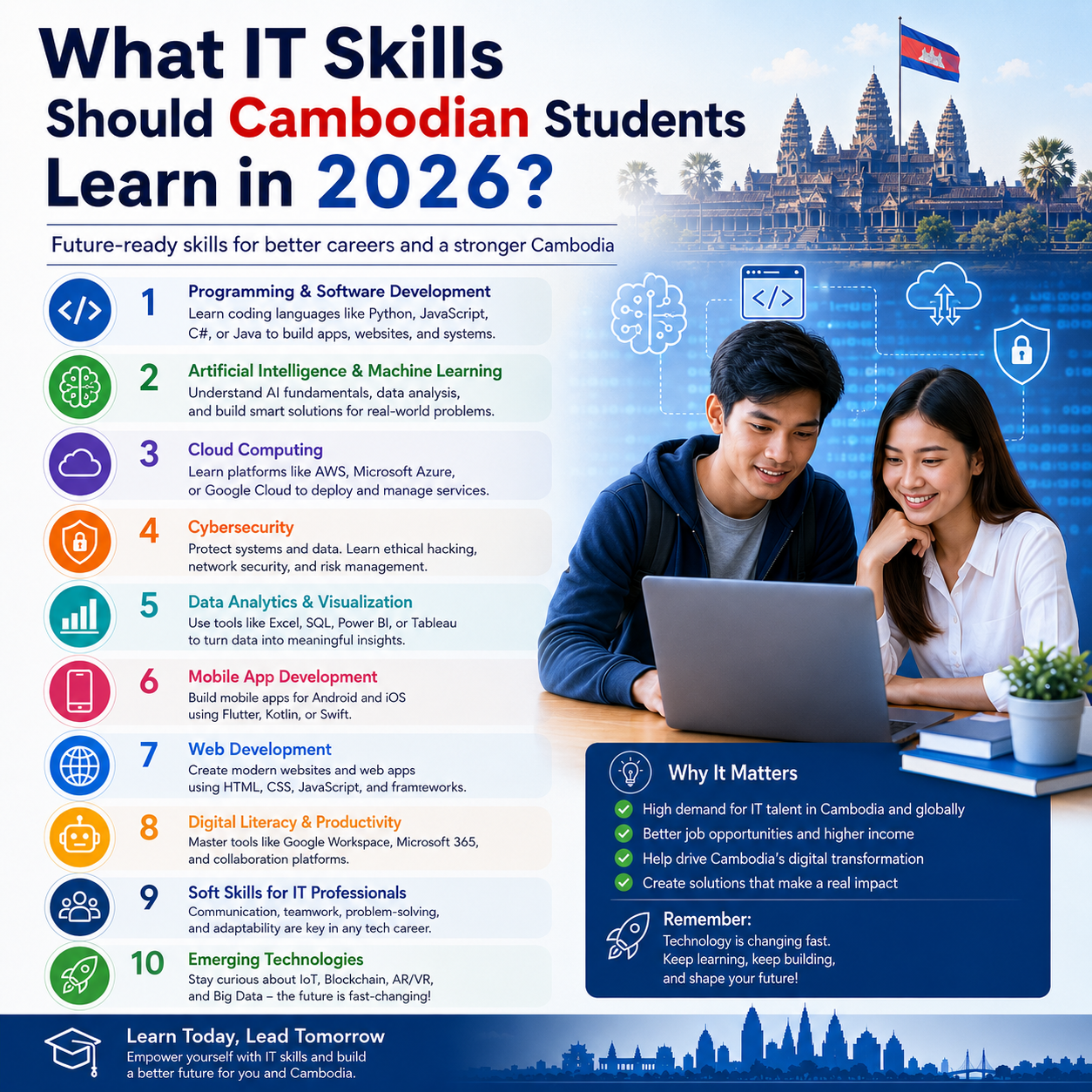
Technology moves fast, and Cambodian students are walking into a job market their parents wouldn’t recognize. A degree still matters, but it’s no longer the whole answer. The better question isn’t “what should I study”. What skills will actually let you find work, build something of your own, and keep learning once the tools you trained on are obsolete. In 2026, that means some mix of AI literacy, programming, data, cybersecurity, cloud basics, networking, and plain old communication. Nobody needs all of it. The goal is a solid foundation, then one or two areas worth going deep on.
Artificial Intelligence and Generative AI
You don’t need to become an AI researcher. You do need to get past the “type a question into ChatGPT” stage. Tools like ChatGPT and other generative AI systems are genuinely useful for research, coding help, writing, data analysis, presentations, translation, and grinding through repetitive tasks. But knowing that isn’t the skill. The skill is AI literacy: writing prompts that actually get you something useful, checking the output instead of trusting it, knowing what a hallucination looks like, and understanding what happens to the data you feed in. Compare “explain cybersecurity” with asking the model to play a cybersecurity instructor walking through a real Cambodian SME scenario. The second gets you something you can actually use. That’s the difference between AI-assisted productivity and just using ChatGPT.
Programming and Software Development
People keep asking whether AI will replace programmers. I think that’s the wrong frame, it’s changing how software gets built, not making the skill pointless. A student who understands what’s happening under the hood can direct an AI tool instead of just accepting whatever it spits out. Python, JavaScript, C#, Java, and SQL are all reasonable starting points. But syntax is the easy part. What actually separates a competent developer from someone who can generate code is understanding algorithms, data structures, object-oriented design, APIs, Git, debugging, testing, databases, and basic architecture. The main concept is you need to understand a problem, build a real solution, and explain why it works.
Data and Data Analytics
Every organization in Cambodia is sitting on data it barely uses. Universities, businesses, ministries most of them are storing records, not learning from them. Useful skills here: Excel, SQL, data cleaning, visualization, statistics, Power BI, Python for analysis, basic database management. Storing ten thousand student records tells you nothing on its own. Analysing them can tell you which courses have the worst failure rates, which students are at risk of dropping out, which programs are actually growing, and how many graduates find jobs. That gap between having data and using it is where the value is.
Cybersecurity
You don’t have to become a penetration tester to benefit from knowing this stuff, and honestly, everyone should have the basics: password hygiene, multi-factor authentication, phishing awareness, malware, social engineering, data privacy, network security, access control, secure coding habits, backups, and incident response. If you want to specialize, there’s ethical hacking, security operations, digital forensics, cloud security, vulnerability management, penetration testing, security monitoring, and identity management to go deeper into. As more Cambodian organizations move their operations online, the cost of not knowing this stuff only goes up.
Cloud Computing
Fewer organizations are running their own physical servers these days. Students should get comfortable with virtual machines, cloud storage, databases, networking, containers, serverless computing, cloud security, and the IaaS/PaaS/SaaS distinctions. AWS, Azure, Google Cloud that pick one and go deep rather than spreading yourself across all three. The fundamentals transfer; the platform-specific knowledge doesn’t need to.
Networking and IT Infrastructure
Networking doesn’t get the hype that AI does, but it’s underneath almost everything else on this list. IP addresses, DNS, DHCP, TCP/IP, routing, switching, Wi-Fi, VPNs, firewalls, troubleshooting, cloud computing, cybersecurity, and enterprise systems all depend on this working correctly. Skip it and you’ll hit a ceiling eventually, even in software development.
Web and Mobile Development
This is probably the most accessible way for a Cambodian student to turn technical skill into an actual, visible project. Websites, online stores, school management systems, booking platforms, business apps HTML, CSS, JavaScript, databases, APIs, and a modern framework will get you most of the way there. Build for mobile first if you can. Most people here access digital services on a phone, not a laptop.
Git, Collaboration, and Modern Development Tools
Here’s something universities tend to skip knowing how to code by yourself isn’t the same as knowing how to work on a team. Git, GitHub, branching, pull requests, issue tracking, code review, documentation that these are the mechanics of actually functioning inside a company. Skip them and your first job will have a rough learning curve you didn’t need.
Digital Business and Entrepreneurship
IT skills don’t have to point toward employment. E-commerce, digital marketing, software services, edtech, agritech, fintech, tourism tech, digital content, AI services, business automation — a small team with limited capital can build something for local businesses and improve it based on real feedback. Pairing technical skill with business sense is a genuinely different, and often more valuable, combination than either one alone.
Communication and English
This one’s underrated. Explaining technical work clearly, writing professional emails, presenting a project, talking to customers, documenting a system, working in a team that a technically strong student who can’t communicate their work will struggle to get credit for it. English matters here too, mostly because so much documentation, tutorials, and professional communication in tech happen in English. It’s not optional the way people sometimes treat it.
Problem-Solving Over Memorization
Technology education leans too hard on memorization. The better question to train students to ask is: what problem are we actually trying to solve? Instead of building yet another student management system as a class project, look for a real problem on campus. Maybe course registration is a mess. Maybe lecturers waste hours on reports. Maybe attendance is still tracked by hand. Interview the people affected, figure out what they actually need, build a prototype, test it, and see if it works. That’s much closer to real IT work than another textbook exercise.
Build a Portfolio, Not Just a Certificate Collection
Build things. That’s the whole recommendation. A stack of certificates doesn’t prove you can do the work. A portfolio does websites, apps, dashboards, AI projects, security labs, database systems, automation scripts, research, open-source contributions. Document what you built, what problem it solved, what you used, and what you learned along the way. That’s what an employer can actually evaluate.
What Universities Should Do Differently
Some of this responsibility sits with the universities, not just the students. If Computer Science and Management Information Systems programs are teaching nearly identical courses, students graduate without a clear sense of what they’re actually qualified to do. A better structure might look like a shared foundation in the early years, followed by specialization:
- Common foundation: Programming, Database, Networking, Operating Systems, Web Development, Mathematics and Statistics, Cybersecurity Fundamentals, AI Fundamentals, Communication
- Computer Science track: Algorithms, Advanced Programming, Software Engineering, AI, Machine Learning, Computer Systems, Advanced Data Structures
- MIS track: Business Analysis, Systems Analysis and Design, Business Intelligence, IT Project Management, Enterprise Systems, Digital Transformation, IT Governance, Business Process Management
That kind of split gives students an actual career direction instead of a diploma that could mean almost anything.
The Real Skill: Learning How to Learn
If there’s one skill on this list that matters more than the rest, it’s not Python or AI or cybersecurity. It’s being able to pick up new technology quickly, because whatever’s popular now won’t stay that way. The right question isn’t “what should I learn so I never have to learn again” there’s no such thing. It’s “how do I get good at learning new tools quickly,” because that’s the one skill that doesn’t expire. Nobody needs to learn everything on this list. Build a solid foundation, pick a specialization or two, get real project experience, and use AI tools with your eyes open rather than blindly. The strongest IT graduates aren’t the ones who can code the fastest they’re the ones who can look at a real problem, figure out what’s actually going on, build something that solves it, explain it to someone else, and keep improving it after it ships. For Cambodian students, that combination of technical skill, AI literacy, security awareness, data fluency, communication, and business sense is worth more than any single certification. The goal isn’t teaching more technologies. It’s teaching students how to use the ones they have to solve problems that actually exist here.