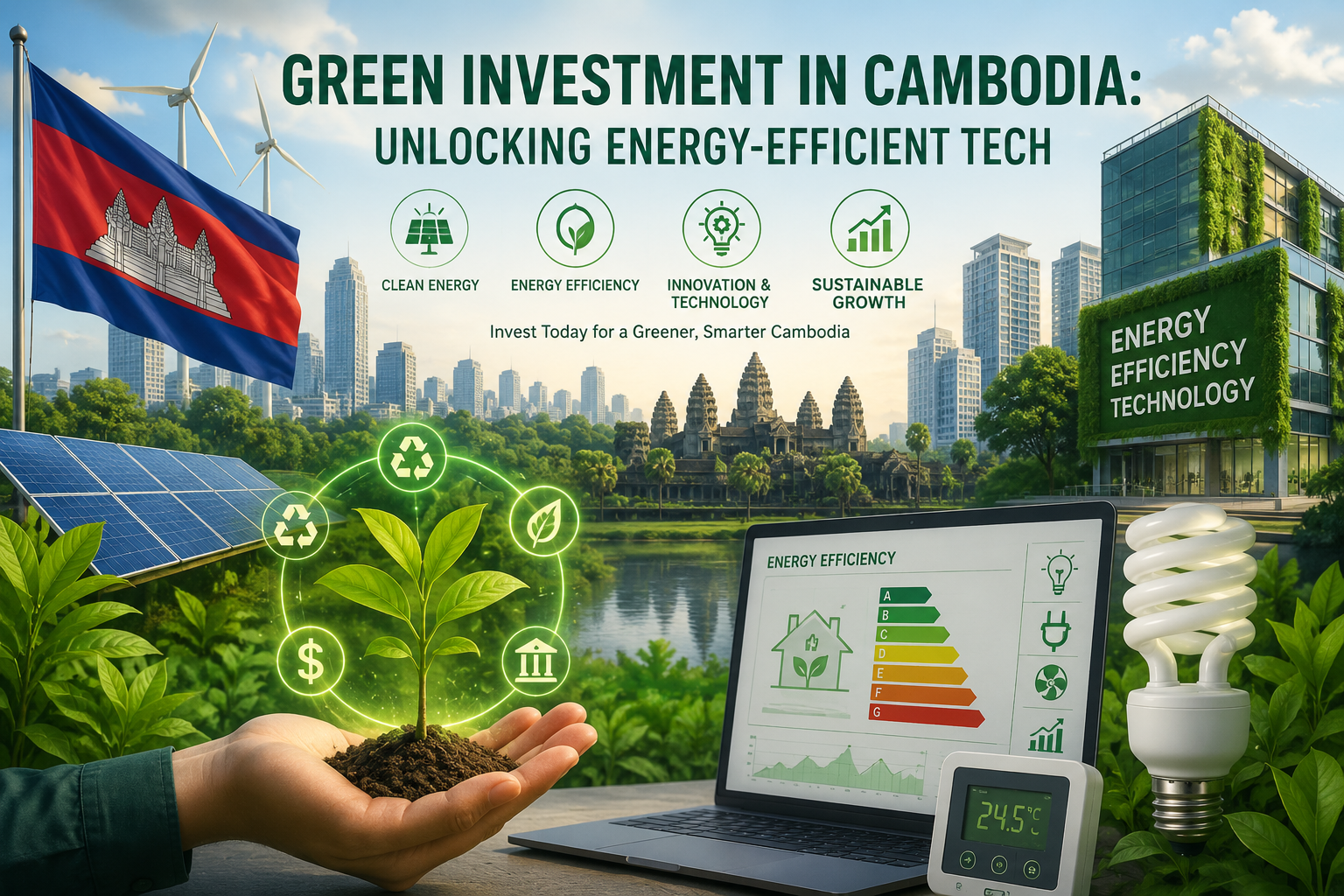
Green Investment in Cambodia: Unlocking Energy-Efficient Tech
Cambodia doesn’t usually come up when people talk about the next big green investment market. Vietnam, Indonesia, and the Philippines tend to dominate that conversation. But look at what’s actually happening on the ground includes factories going up outside Phnom Penh, hotels multiplying in Siem Reap, industrial parks spreading along the coast near Sihanoukville and a different story starts to take shape. All of that growth needs power, and how Cambodia meets that need is turning into a real opportunity for investors willing to look past the obvious markets.
Growth That Outpaces the Grid
Cambodia’s economy has changed shape over the last twenty years. Manufacturing, construction, tourism, agriculture, and services have all expanded, and foreign direct investment has followed. Garments, footwear, travel goods, electronics, and light manufacturing have set up shop here, partly because global manufacturers are spreading their supply chains around Southeast Asia and Cambodia offers a competitive labor force, a useful location, and access to regional trade agreements.
None of that growth is free, energy-wise. Every industrial park, logistics centre, hospital, university, and apartment block that goes up adds to electricity demand. That’s a problem country has solved in different ways over the years, and one of the cheapest, fastest fixes aren’t building more power plants. It’s using the power you already generate more efficiently. Cambodia hasn’t fully leaned into that approach yet. Which is exactly why there’s room for investors to get in early.
Why Efficiency, Not Just Generation
For a long time, energy investment meant power plants, pipelines, and transmission lines and all the stuff that produces electricity. Lately, more money has gone toward the other side of the equation: not wasting the electricity that already exists.
The International Energy Agency likes to call efficiency the “first fuel,” on the logic that the cheapest kilowatt-hour is the one nobody had to generate. Every unit of energy saved cuts a business’s operating costs, delays the need for new infrastructure, and lowers emissions in one move.
The technologies driving this aren’t exotic. Smart building management systems, high-efficiency HVAC, LED lighting, industrial automation, variable-speed motors, better refrigeration, insulation, energy monitoring software, heat recovery systems and none of it is cutting-edge in the way solar panels or EV batteries once were. It’s mature, proven, and, in most cases, pays for itself.
That last part is the pitch. Efficiency upgrades usually cost more upfront, but the payoff comes in lower electricity bills, less equipment downtime, and fewer maintenance headaches over the years that follow. For investors, that translates into something rarer than it sounds: returns tied to measurable savings rather than to how well a market happens to be doing that quarter.
There’s also the ESG angle, which matters more than it used to. Pension funds, development banks, and institutional investors are actively hunting for projects that check both boxes in solid returns and a real environmental case. Cambodia’s expanding market for sustainable infrastructure gives them somewhere to put that money.
Where This Leaves Cambodia
None of this makes Cambodia a finished story. Financing gaps are real, technical expertise is still thin in places, and plenty of local businesses simply haven’t thought much about energy efficiency yet. Those are genuine obstacles, not footnotes. But the direction of travel is favourable. Government reforms are moving, multilateral development institutions are paying attention, and green finance is becoming easier to access than it was even a few years ago. None of that guarantees success, but it does mean the pieces are starting to line up. Energy efficiency has stopped being a side conversation in global investment circles and become part of the main one. Cambodia, with its growth trajectory and its still-developing energy infrastructure, is a market where that shift is just getting started — which is usually the best time to pay attention.