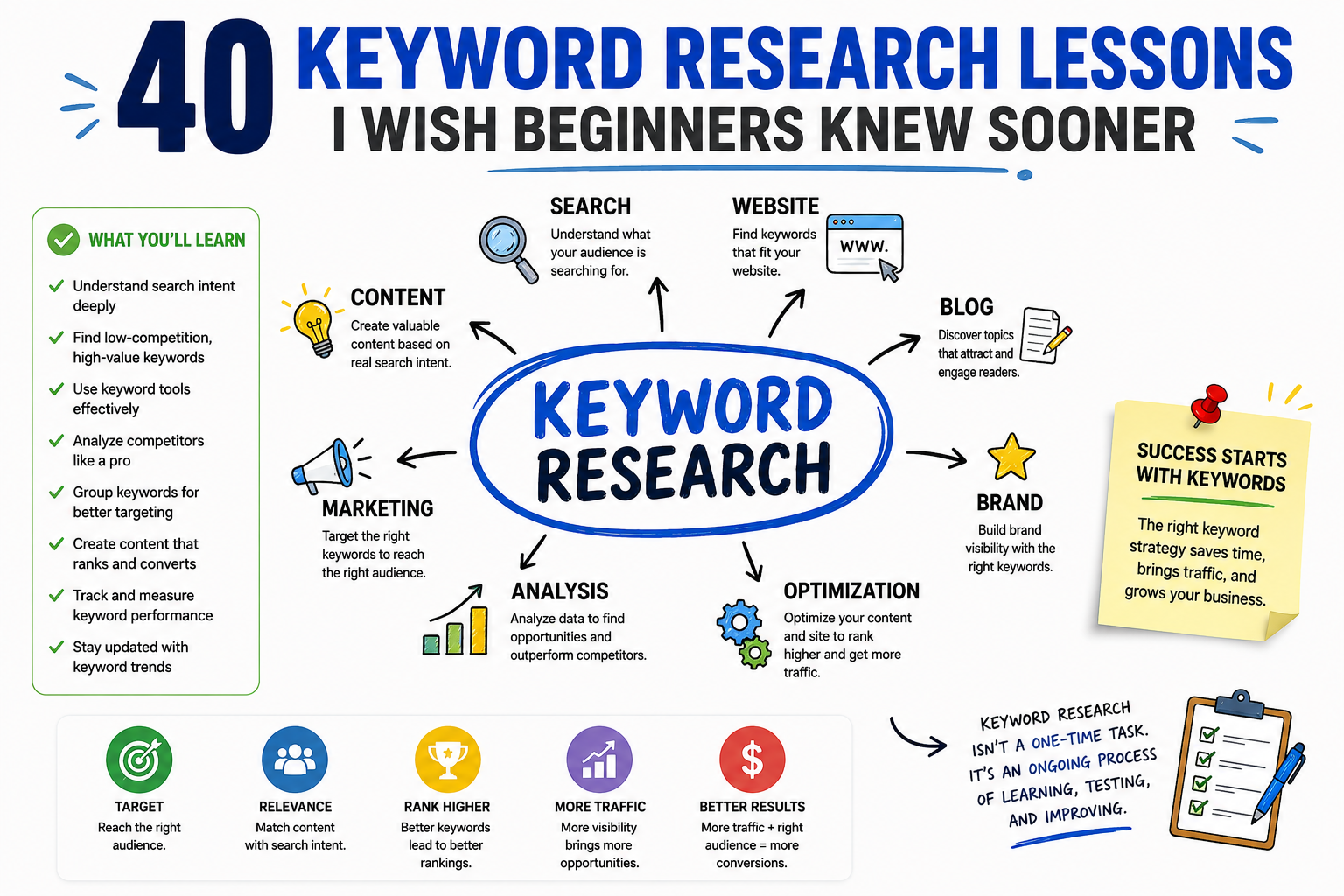
40 Keyword Research Lessons I Wish Beginners Knew Sooner
Keyword Research Isn’t a Maze, It Just Feels Like One
Here’s the thing nobody tells you when you start learning SEO: keywords are just the words people type into Google. That’s it. Keyword research is the process of finding those words and phrases so you can build content around what real humans are actually searching for, instead of guessing. I’ve watched a lot of beginners burn weeks chasing the wrong metrics or copying tactics that stopped working years ago. So, here’s a rundown of what actually matters when you’re researching keywords, and right after it, the traps that will waste your time or get your site penalized.
What to Get Right
- Figure out the intent first. Before anything else, ask why someone is typing that phrase. Are they ready to buy, trying to learn something, hunting for a specific website, or looking for a place near them? Get this wrong and nothing else matters.
- Long-tail phrases convert better than you’d expect. Something like “best organic coffee beans for cold brew” won’t pull huge traffic, but whoever types that knows exactly what they want. Fewer visitors, more buyers.
- Keyword Difficulty is a warning label, not gospel. Most SEO tools score terms 0 to 100 based on how tough the competition is. Treat it as a rough guide, not a rule.
- Search volume tells you potential, not guaranteed traffic. It’s the average monthly searches for a term. Useful for sizing up an opportunity, but I wouldn’t build a whole strategy around it alone.
- Semantic keywords tell Google what you actually mean. If your main term is “Apple,” related words like “iPhone” or “Tim Cook” signal you’re talking about the company, not the fruit.
- Look at what’s already ranking. Actually search your target keyword and see what Google shows. If page one is wall-to-wall videos, writing a 2,000-word article probably isn’t going to cut it.
- Find the gaps your competitors left open. Look at what they rank for that you don’t touch at all. That gap is often where the easy wins live.
- Start broad, then narrow. Seed keywords like “shoes” or “fitness” are your jumping-off point for finding the more specific phrases underneath them.
- One primary keyword per page, a handful of backups. Give each page a main target and 3 to 5 supporting variations. Spreading yourself thinner than that just dilutes everything.
- The “People Also Ask” box is basically free research. Google is handing you the exact follow-up questions your audience has. Use it.
- Don’t sleep on local intent. If you serve a specific area, phrases like “plumber near me” or “boutiques in Phnom Penh” matter more than the global numbers suggest.
- Watch for pages fighting each other. Keyword cannibalization happens when two pages on your own site target the same phrase and end up competing with themselves. It’s a self-inflicted wound.
- Plan around the calendar. Some terms spike hard at predictable times, tax topics in spring, gift guides in December. Build your content schedule around that rhythm instead of reacting to it.
- High volume doesn’t always mean high traffic. If a keyword triggers a big AI summary or answer box, people might get what they need right there on Google and never click through.
- Write for humans first, keywords second. If a phrase reads awkwardly in a sentence, rewrite the sentence. Google rewards readability over rigid phrase matching, and so do actual readers.
- Split your attention between branded and non-branded terms. Your company name matters, but if you’re just starting out, non-branded industry terms are how new people find you at all.
- Check that a trend is actually still trending. A tool like Google Trends can tell you whether a keyword’s popularity is holding steady or quietly dying.
- Google already understands synonyms. You don’t need a separate page for “how to fix a car” and “how to repair an automobile.” One good page covers both.
- A small, relevant audience beats a big, irrelevant one. Fifty monthly searches perfectly matched to a high-ticket service you offer will outperform ten thousand searches that have nothing to do with what you sell.
- Don’t ignore the “zero search volume” terms. If real customers keep asking you the same question over email or support chat, write about it, whatever the SEO tool says.
What to Avoid
- Stuffing keywords into every sentence. It reads terribly, and it’s one of the fastest ways to trigger a spam filter.
- Going after massive, generic terms with a brand-new site. Trying to rank for “insurance” or “credit cards” out of the gate means competing with brands that have a decade of authority on you. You’ll lose.
- Matching the wrong intent to the wrong page. Someone ready to buy who lands on a 5,000-word history essay is gone in seconds.
- Betting everything on single-word head terms. They’re expensive, brutally competitive, and rarely the ones that actually convert.
- Trusting one tool’s numbers as absolute truth. Not even Google’s own Keyword Planner is fully accurate. Cross-check across a few sources.
- Confusing global search volume with your actual market. A local business optimizing around global numbers is optimizing for people who will never walk through the door.
- Finding the perfect keyword, then never using it. Doesn’t matter how good your research is if the term never makes it into your title tag or H1.
- Building near-duplicate pages for every nearby town. “Best dentist in suburb A,” “best dentist in suburb B,” and so on. Google sees through it, and honestly, so do people.
- Twisting your grammar to match a clunky search query. Nobody actually wants to read “we offer cheap flights London Paris.” Write like a person; Google can handle the phrasing.
- Assuming a keyword means the same thing forever. Cultural shifts and news events can quietly change what people mean when they type a phrase. Check in on your top terms once in a while.
- Forgetting to check the mobile results. Ads and map packs can bury organic results on a phone screen in a way they never would on desktop.
- Writing “click here” for every internal link. Descriptive, keyword-rich anchor text does real work. Generic link text wastes the opportunity.
- Chasing traffic that can’t actually afford you. Thousands of visitors mean nothing if none of them have the budget or the intent to buy what you sell.
- Publishing and walking away. Rankings shift. If you never check back in, you won’t know you’ve slipped until the traffic’s already gone.
- Copying a competitor’s keyword list without asking why. Just because they target something doesn’t mean it fits your actual business.
- Hiding white text on a white background. This is an ancient black-hat trick, and it’s a fast way to get your whole site penalized. Not worth it, not even a little.
- Targeting sensitive money or health topics without the credentials to back it up. Google holds finance and health content to a higher bar for good reason, and skipping that bar can tank your visibility.
- Leaving your images untouched. File names and alt text are still prime real estate for natural keyword variations, and most sites just… don’t bother.
- Treating research as a one-and-done project. Search behavior moves. Revisit your keyword strategy at least once or twice a year, not once ever.
- Writing for the algorithm instead of the person reading it. This is the one that undoes everything else. If the content doesn’t actually answer a real question well, none of the technical stuff matters much.
Keyword research isn’t complicated once you strip away the jargon. Find out what people are actually asking, match it honestly to what you offer, and write like you’re talking to a person instead of gaming a system. Get those three things right and most of the rest takes care of itself.