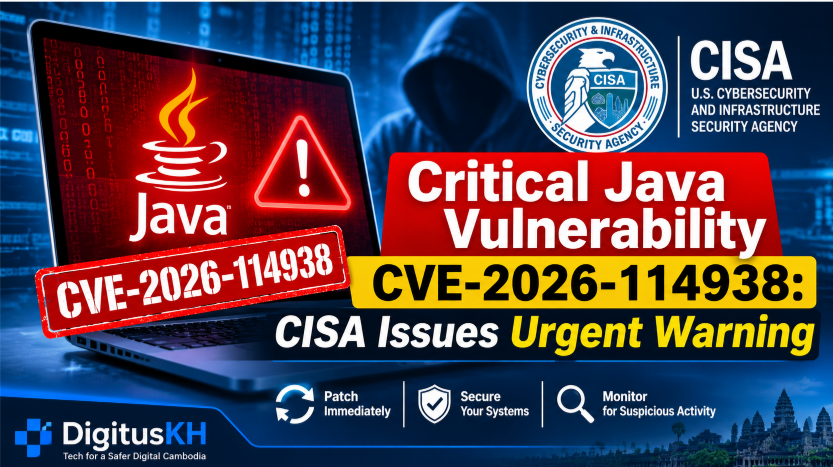
Critical Java Vulnerability CVE-2026-114938: CISA Issues Urgent Warning
CISA is urging organizations to patch a critical Java flaw, CVE-2026-114938, nicknamed Java4Shell. It sits in the Base64 decoder of the x86-64 HotSpot JVM, which ships as part of the JDK.
A specially crafted Base64 string can corrupt memory. That can crash a Java process or leak data from memory, and it could potentially allow remote code execution without authentication. Java runs a huge share of enterprise applications, web services, and backend systems, so most organizations have something to check.
What Java4Shell is
It’s a memory-corruption bug in Java’s Base64 decoding. Base64 turns binary data into text, and it turns up in authentication tokens, API traffic, and file handling. That means a lot of Java code passes untrusted input through it.
If an attacker can get crafted input to a vulnerable process, the worst case is code execution on the host. Short of that, they could corrupt JVM memory, read sensitive data out of application memory, or crash the service. Whether they need credentials depends on how the application exposes the decoder. If it handles untrusted input before login, they may need none.
Which systems may be affected
Check Oracle Java SE, OpenJDK, and GraalVM. These builds have been tied to the flaw:
| Java environment | Affected release |
|---|---|
| Oracle Java SE 8 | 8u511b33-perf |
| Oracle Java SE 17 | 17.0.21 |
| Oracle Java SE 21 | 21.0.13 |
| Oracle Java SE 25 | 25.0.5 |
| Oracle Java SE 27 | 27.0.1 |
| Oracle GraalVM for JDK | 17.0.21 and 21.0.13 |
| Oracle GraalVM Enterprise Edition | 21.3.20 |
This is a list of affected build identifiers, not every vulnerable distribution. Confirm your exposure and the correct fixed versions in Oracle’s advisory and your own Java vendor’s guidance.
Hardware matters too. The flaw is tied to x86-64 CPUs with AVX-512 VBMI instructions, so exposure depends on the Java build, the processor, and whether attacker-controlled input can reach the vulnerable code. And don’t assume you’re clear because Java isn’t in your software inventory. It may be bundled inside another product.
What CISA recommends
- Inventory every Java install: JDKs, JREs, and other Java components on servers, workstations, VMs, and cloud environments.
- Patch with the updates from Oracle and other affected vendors. Do internet-facing systems first.
- Check third-party software for bundled runtimes, including enterprise applications, application servers, containers, and appliances.
- If you can’t patch yet, restrict unauthenticated access to vulnerable applications, validate and cap incoming Base64 input, and tighten network access.
- Watch for signs of attack: unexpected JVM crashes, unusual Java processes, odd outbound connections, and endpoint alerts.
- Follow Oracle and your other Java vendors for updated patches, affected-product lists, and mitigation guidance.
What IT administrators should do now
For IT teams the job is to find Java, patch it, and watch for trouble. This checklist covers it:
- [ ] Identify all Java installations and versions.
- [ ] Check Java components embedded in third-party applications.
- [ ] Determine whether systems use affected x86-64 hardware and Java builds.
- [ ] Prioritize internet-facing applications and critical business systems.
- [ ] Apply the appropriate vendor security updates.
- [ ] Restrict access to vulnerable services until patching is completed.
- [ ] Review application and endpoint logs for suspicious activities.
- [ ] Document remediation activities and verify patch installation.
To see the installed Java version:
bash

java -version
On Linux, this shows whether the CPU reports AVX-512 support:
bash

lscpu | grep avx512
Neither command tells you whether a system is vulnerable. That takes the full Java build, the CPU, and how the application is exposed.
Why this matters in Cambodia
Java is used across Cambodian government, banking, telecoms, education, and private business, and many of these systems are connected. A flaw in a widely deployed component can spread risk across all of them. Where to look:
- Government: public portals and internal applications built on Java.
- Banks and payment providers: core banking, payment services, and backend systems.
- Telecoms: network management, customer platforms, and enterprise services.
- Private companies: application servers, business software, APIs, and cloud workloads.
- IT service providers: Java bundled into the products and services they sell to customers.
In Short,
Java4Shell is a patch-now issue. Find your Java installs, including the ones bundled in other software. Confirm which builds and CPUs are exposed, apply the vendor fix, and watch your logs for crashes and strange behavior until you have.
References and Further Reading
- CISA: Critical Java Vulnerability Requires Immediate Patching – November 17, 2026
- Canadian Centre for Cyber Security: Critical Vulnerability Impacting Oracle Java – CVE-2026-114938
- Oracle: Critical Security Patch Update Advisory – November 2026
Disclaimer: This article is an independent editorial summary for cybersecurity awareness. Readers should consult official vendor advisories for the latest affected versions, confirmed fixes, and technical remediation instructions.