How to Make Money from a WordPress Website: 5 Proven Methods That Actually Work (2026)
There’s no magic formula here. What works depends almost entirely on how much traffic you’re pulling in and what your site is about. Try to bolt on every monetization method at once and you’ll just burn yourself out and annoy your readers in the process. Pick one or two things that fit where you’re at, get them working, then add more.
Here’s a rundown of the main options, how each one actually functions day to day, and roughly when it makes sense to bother with them.
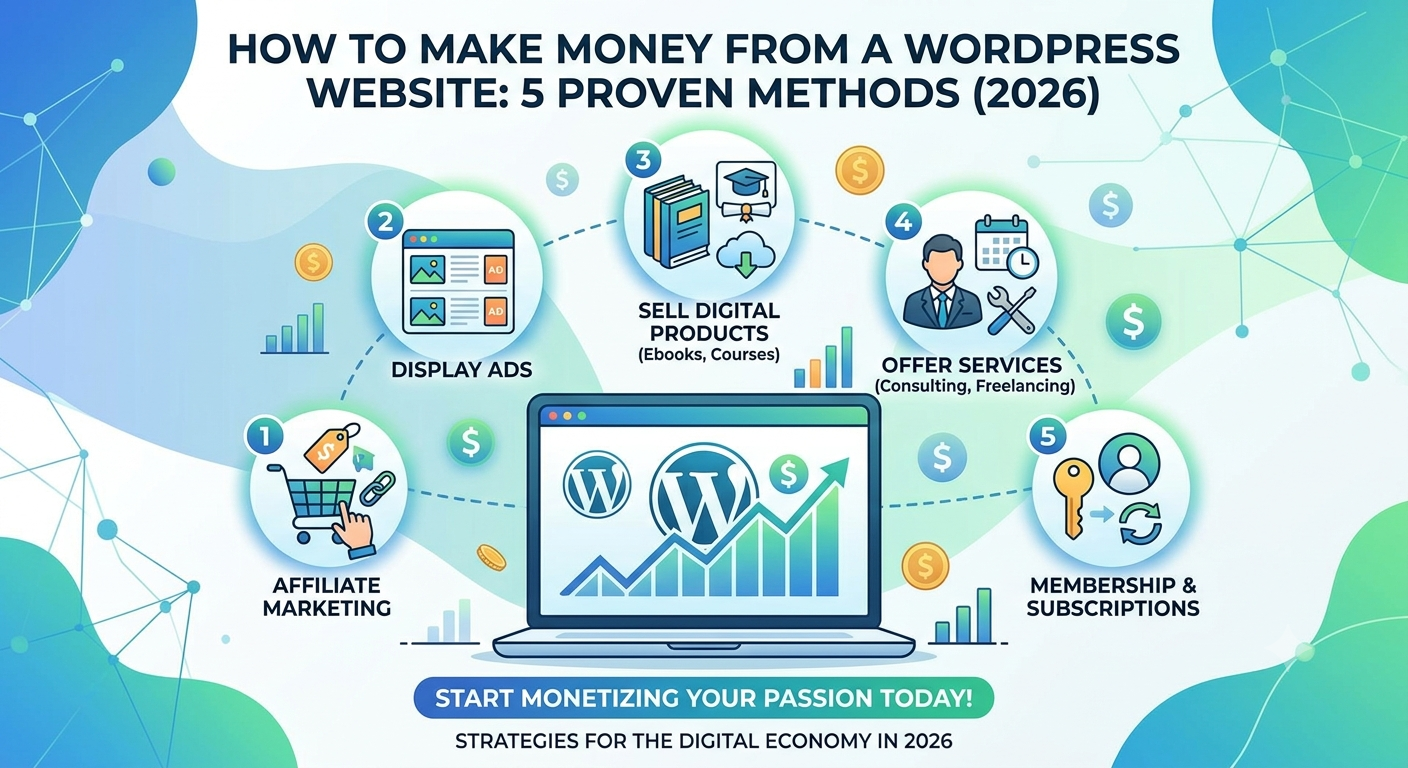
1. Affiliate Marketing
This is usually the easiest place to start because you don’t need much traffic at all. You recommend a product or service in your content, someone clicks your link and buys, and you get a cut. In practice, that means writing genuinely useful buying guides and comparisons. Think “Best Running Shoes for Beginners” or “Top 5 Web Hosting Providers for Small Businesses.” Readers can tell when a link is shoved in as an afterthought versus when it’s actually part of you helping them decide something. The second kind converts. The first kind doesn’t. Pretty Links and Thirsty Affiliates are both decent for cleaning up ugly affiliate URLs into something like yoursite.com/go/hosting, and they’ll show you which links people are actually clicking. Amazon Associates is the obvious starting point because the catalog is enormous, though the payout per sale is thin. Share Sale and CJ Affiliate cover a lot more brands and tend to pay better. If your site leans technical, going direct to software companies (hosting, VPNs, AI tools, SaaS in general) is often worth it. I’ve seen recurring commissions in the 20 to 40 percent range there, compared to a one-time 3 to 5 percent from a typical retail affiliate program. The nice thing about this model is it doesn’t care how small you are. A site pulling a few hundred visits a month can still make real money if that content ranks for the right buyer-intent search terms.
2. Display Ads
If your traffic is more general (news, recipes, how-to content, that kind of thing), automated display ads are about as hands-off as monetization gets. An ad network drops ads into your sidebar, header, or between paragraphs, and pays you based on views and clicks. You never talk to an advertiser directly. Google AdSense is where almost everyone starts since there’s no traffic minimum. It just doesn’t pay much per view. Once you’re consistently hitting somewhere around 10,000 to 50,000+ monthly pageviews, you can apply to the bigger networks: Ezoic, Mediavine, Raptive (the old AdThrive). These negotiate on your behalf and usually pay two to five times more per thousand impressions than AdSense alone. Honestly, don’t expect display ads to carry a site. They’re a nice bonus once you have volume, not something worth building a strategy around early on.
3. Sell Your Own Digital Products or Courses
This is the one where you keep basically all the money, minus payment processing fees. No middleman, no inventory, no shipping. You take what you know and turn it into something sellable: PDFs, templates, an eBook, a spreadsheet, a video course. The trick is solving one specific problem your audience already has rather than trying to cover everything. Narrow and useful beats broad and generic almost every time. Easy Digital Downloads handles simple file sales cleanly: licensing, delivery, payment, all in one place. If you’re building something bigger, like a full course with quizzes and drip content, LearnDash or Tutor LMS are the standard picks. This tends to work best for people with real, specific expertise. Cybersecurity, AI tools, design, marketing, technical training. People will pay for that kind of thing packaged well instead of piecing it together from scattered free posts.
4. Membership Site
Instead of a one-off sale, people pay you monthly or yearly for access to premium content, a community, or some kind of ongoing perk. It’s a much steadier income than affiliate or product sales, which can swing wildly month to month. You put your best material behind a paywall (deep tutorials, reports, download libraries) while keeping enough free content out front to pull people in and show them what they’d be paying for. MemberPress is the most common all-around tool for this. Restrict Content Pro and ARMember are solid alternatives if you want finer control over access tiers. I’d wait on this one until you already have people coming back regularly. It’s a lot easier to convert an existing reader into a paying member than to build a subscriber base from zero, so treat this as a mid-to-late-stage move, not a starting point.
5. Sell Services, Coaching, or Consulting
This is the odd one out on this list because it doesn’t need traffic at all, really. If you know your subject well, your site works as a portfolio that gets you clients directly. A simple “Work with Me” page lets people hire you for freelance work, an audit, design, development, or coaching. One client can easily outearn months of ad revenue or a pile of digital product sales.Amelia and LatePoint both handle scheduling and deposits on-site, so you’re not stuck emailing back and forth to book a call.
Of everything here, this is usually the fastest to actually pay off, because it doesn’t depend on SEO, traffic, or getting accepted into an ad network. It depends on whether your content makes someone trust you enough to reach out.
Before Any of This Works
None of the above matters much if your site is slow or a pain to use. Get an SEO plugin like Rank Math running so your content can actually be found, and a caching plugin like LiteSpeed Cache or WP Rocket to keep pages loading fast. A visitor who bounces before the page loads was never going to click your affiliate link anyway.
Matching the Strategy to Where You’re At
The biggest mistake I see is people trying to run five monetization methods on day one. It spreads your effort thin, and a site plastered with ads, popups, and sales pitches before it’s earned any trust tends to push people away rather than convert them. Better to think of it in stages.
- 0 to 1,000 monthly visitors: Display ads won’t do anything for you yet, so don’t bother. Stick to affiliate marketing in high-intent content, and if you have relevant expertise, put up a services or consulting page. Neither of these needs volume, just the right reader at the right moment.
- 1,000 to 10,000 monthly visitors: This is a reasonable point to turn on AdSense as a small extra stream, and to start building an email list. An email list is genuinely one of the more valuable things you can build here. It gives you a direct line to your audience for products, courses, or affiliate offers, without depending on Google or social platforms to show up in someone’s feed.
- 10,000 to 50,000 monthly visitors: Sponsored content, membership tiers, and courses start becoming realistic. Brands are more willing to pay once you have real numbers to show them, and readers are more willing to pay once they’ve gotten value from your free stuff first.
- 50,000+ monthly visitors: Apply to the premium ad networks for better rates, consider a paid job board or directory if it fits your niche, and start looking at bigger partnerships, webinars, or even building your own tool or SaaS product around what your audience already needs.
Things That Trip People Up
- Monetizing too early. Five ad networks and a dozen affiliate links on a brand-new site with no trust built up usually backfires. People notice when content exists to sell them something rather than help them.
- Ignoring page speed. A slow site quietly kills every monetization method at once. It doesn’t matter how good the offer is if the visitor’s already gone.
- Jumping to premium ad networks too soon. Applying to Mediavine or Raptive before you hit their traffic thresholds is just wasted time. Start with AdSense and move up once you qualify.
- Forgetting mobile. Most content traffic is mobile now. Ads, popups, and checkout flows that aren’t built for small screens will quietly tank your conversions and you might not even notice why.
- Betting everything on one income stream. An algorithm update, a policy change, a seasonal dip in ad spend, any one of these can wipe out a single revenue source overnight. Spreading across two or three methods protects you from that.
Actively looking for practical ways to generate income using WordPress
There isn’t one right way to do this. It depends on your traffic, your niche, and how hands-on you want to be. Early on, affiliate marketing and consulting are your fastest paths to actual money since neither needs a big audience. As things grow, ads and digital products start pulling their weight, and once you’ve built real authority, memberships, courses, and sponsorships become genuinely lucrative.
Don’t pick one method and hope. Layer in a couple that fit where you are right now, and add more as your traffic and reputation catch up. And whatever you choose, none of it works particularly well on top of a weak site. Good content, a clear niche, and a fast, well-built foundation will always outperform a pile of monetization tactics stacked on something shaky.