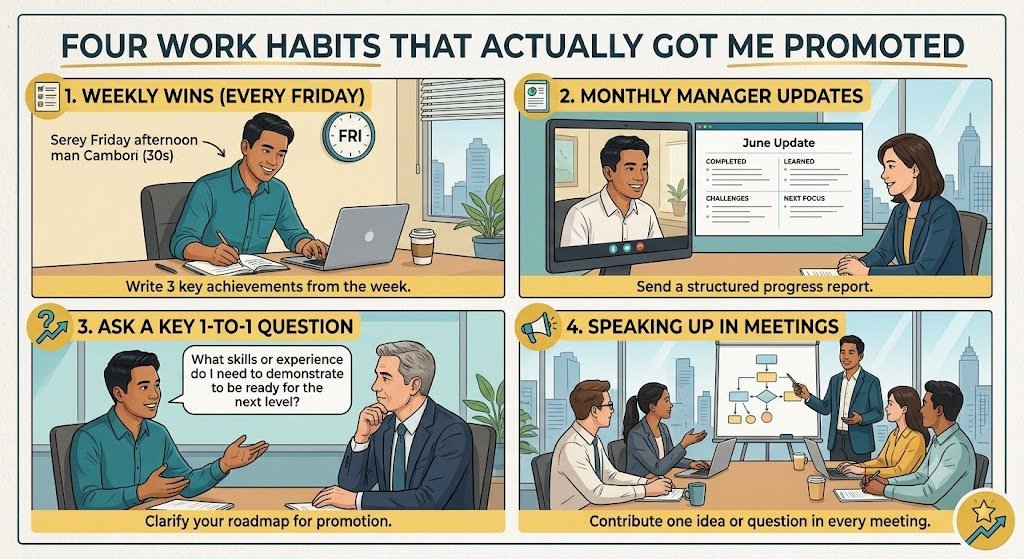
Four Work Habits That Actually Got Me Promoted
A few years ago, I was stuck. Be early to the office, and last to leave from day to day because I wanted to get someone’s attention. It didn’t. Promotion cycles came and went, and my name wasn’t on the list, even though I was clearly working harder than most of the people who did make it. Eventually I landed on an uncomfortable truth that doing good work isn’t enough on its own. Why? Managers are too busy and the teams are matrixed. Good results quietly disappear into the noise of a normal quarter unless someone points at them. If you want to move up, you have to manage the story of your own work, not just the work itself. Therefore, I built four habits. Nothing dramatic. But six months in, they’d changed how leadership talked about me from “reliable” to “ready for the next level.”
1. Weekly wins (Every Friday)
Every Friday, during the last six month I could barely remember what I’d done. I started a running document I called my Value Log. Every Friday at 4pm, I spend fifteen minutes to list down three things I’d done or moved forward that week. Even if how it small. A few things happened. First, it fixed the recency bias problem. A manager is grading you on the last three weeks doesn’t care that you crushed it in Q1. Second, it forced me to stop logging tasks and start logging outcomes. Third, honestly, it just felt good. A month with twelve logged wins is proof you’re moving, even on weeks that feel flat. By the time my formal review came around, I wasn’t scrambling to remember my own year. I opened the log, pulled the strongest entries, and had my case already built.
2. Monthly manager updates
One thing I got wrong for years is assuming my manager was tracking my work closely. He wasn’t. He had his own job, plus peers, plus other reports. Not because he didn’t care yet he just didn’t have the bandwidth or time. Honestly, I wouldn’t want a manager hovering that closely anyway. To approach his views, the last working day of each month I sent a short, scannable email that consist of the same items for him to read as below:
- What I finished within a month, he real milestones, tied back to team goals, not a task dump.
- What I learned so far, a tool I picked up, feedback I acted on. This part matters more than people think; it signals you’re not on autopilot.
- What I was stuck on by stopping hiding blockers. I’d name the problem and bring at least one idea for fixing it, never just a complaint.
- What’s next. My priorities for the coming month, so he could redirect me early if team priorities shifted without me knowing.
The effect was bigger than I expected. He stopped needing to check in on me, which built real trust. And by review time there were no surprises, because he’d been reading a steady trickle of my work for months already.
3. Ask this question during a one-to-one (simply direct face to face meeting)
For a long time, my one-to-one meetings with my manager were entirely tactical. We discussed project deadlines, active roadblocks, and immediate administrative needs. The useful for daily operations, these conversations did absolutely nothing to signal my long-term ambitions or career trajectory.
“What would I need to show over the next two quarters to be ready for the next level?” this was because I realized I needed to shift the nature of these meetings from operational to strategic. To do this, I chose a quiet, low-stress one-to-one session and asked a very specific, deliberate questions.
Simple phrase was that should be asked “what needs to be earned through future performance.” It forces a concrete answer rather than a usual vague. One the answer was replied, I started aligning and documented the criteria we discussed with my daily tasks to meet those exact expectations.
4. Speaking up in meetings
I used to be the quiet note-taker, telling myself I was being respectful, waiting for some perfect insight before opening my mouth. Which meant I basically never talked. Unfortunately, in a corporate setting, silence is frequently misread as a lack of engagement, lack of knowledge, or a lack of confidence that turns out silence as disengagement, and not thoughtfulness. The people getting pulled into the high visibility were the ones talking. Therefore, I set a dump that I must force myself to break my silence by setting a simple personal rule “Contribute at least once in every single meeting I attended.”
Small but consistent contributions build very significant professional presence over time. By speaking up, I stopped being just a name on an email thread and became a living, thinking participant in the room. When leadership teams later sat down behind closed doors to discuss who possessed the communication skills and confidence required for a step up, they remembered me as someone who consistently added value to the conversation. Consistency is one of the compounding effects that bring people over a six-month period, through these four subtle routines and it completely shifted how people interacted with me and perceived my work. It kept me honest about impact and provide me monthly updates to keep my manager informed and aligned without me having to chase his down. The perfect moment of one-to-one question gave us both a shared target while speaking up at least one in the meeting made the work visible to people who weren’t even in my direct chain.
Throughout this scenario, I realized something that so important is nobody gets promoted as a surprise reward for quietly working hard in a corner. To get promoted, we need to be seen by people that can already picture you at the next level